
GMP Audit Procurement Records: What an Auditor Needs to Trace
TL;DR The revised Schedule M (Drugs (Amendment) Rules 2023, G.S.R. 922(E), 28 December 2023) asks pharma manufacturers to evaluate and approve suppliers, buy starting materials only from approved suppliers, record each receipt with supplier, batch and quantity, and keep records at least one year after the finished product’s expiry date. For procurement, one batch should trace back to its supplier approval, its order and its receipt without anyone hunting. Pick three batches and time each trace.
When an auditor picks a finished batch and asks where its solvent came from, the answer has to come from your procurement records: the supplier’s approval, the order and its approval, and the receipt. Quality owns the supplier approval, but the record of it has to be one procurement can reach. This post is for pharma Procurement Heads at Growth (Automate) and Enterprise (Orchestrate) companies. It covers which of those records the revised Schedule M asks for and how to check yours.
What does the revised Schedule M ask of procurement?
It asks that suppliers are evaluated and approved before you buy, that starting materials come only from approved suppliers, and that every receipt is recorded. The notified text says:
- Suppliers are evaluated before they are approved and added to the approved list. The evaluation takes the supplier’s history and the nature of the material into account, and if an audit is required it determines the supplier’s ability to conform to good manufacturing practice (clause 10.8.2).
- Starting materials are purchased only from approved suppliers and, where possible, directly from the producer (clause 14.8).
- Each delivery of starting material has a receipt record. It includes the material’s name on the delivery note, the in-house name or code, the date of receipt, the supplier’s name and, if possible, the manufacturer’s name, the manufacturer’s batch or reference number, the total quantity and number of containers, and the batch number assigned after receipt (clause 17.3.10.3).
- Records are made when an action is taken, so that significant activities are traceable, and are kept at least one year after the expiry date of the finished product (clause 17.2.7).
- The person responsible for quality control, together with other relevant departments, approves suppliers (clause 10.8.1).
This is a procurement reading of the notified text and is not regulatory advice. Check the wording with your quality and regulatory team.
What do GMP audit procurement records need to show for one batch?
A trace from batch to supplier needs five things, each findable without asking a person.
- The supplier’s evaluation, and the audit where one was required, dated before the first order.
- Proof the supplier was on the approved list when the purchase order (PO) was placed.
- Who approved the order, when, and on what basis. This follows from the traceability clause (17.2.7), and it is not a separate requirement.
- The receipt record with supplier, manufacturer’s batch number and quantity.
- All of it retained for the period the rules set, and retrievable.
One batch, traced
Example: an auditor takes a batch of finished product made at one plant and asks for the solvent lot it used. You find the receipt record, which names the supplier and the manufacturer’s batch number. The auditor asks when that supplier was approved and who approved the order. The supplier approval sits in the quality team’s file, the order approval sits in an email thread at the plant that placed the order, and the receipt sits in the ERP. Each answer needs a different person at a different site, and the trace waits on whoever replies last. Each hand-off is a call or a message, and each one is time your team spends chasing a record.
How can you check your own records before an audit does?
Pick three starting-material batches from three suppliers and trace each back: receipt, then order approval, then supplier approval. Time each trace and note every step where you had to phone or message a colleague, because an auditor would have to ask at the same points.
How PRMAI keeps the procurement trail in one place
PRMAI works alongside your ERP. Vendor onboarding sends the supplier a registration form for documents such as GST and MSME, routes the vendor for internal approval, and creates the vendor code in your ERP once approved.
When a quote comparison is approved, the approver records a justification and can attach documents, so the basis for the order sits with the approval. The goods receipt note (GRN) is created in your ERP and fetched back against the PO. Supplier Risk Watch tracks vendor compliance expiry and tells the manager what needs action today.
See the pricing page for what each plan includes.
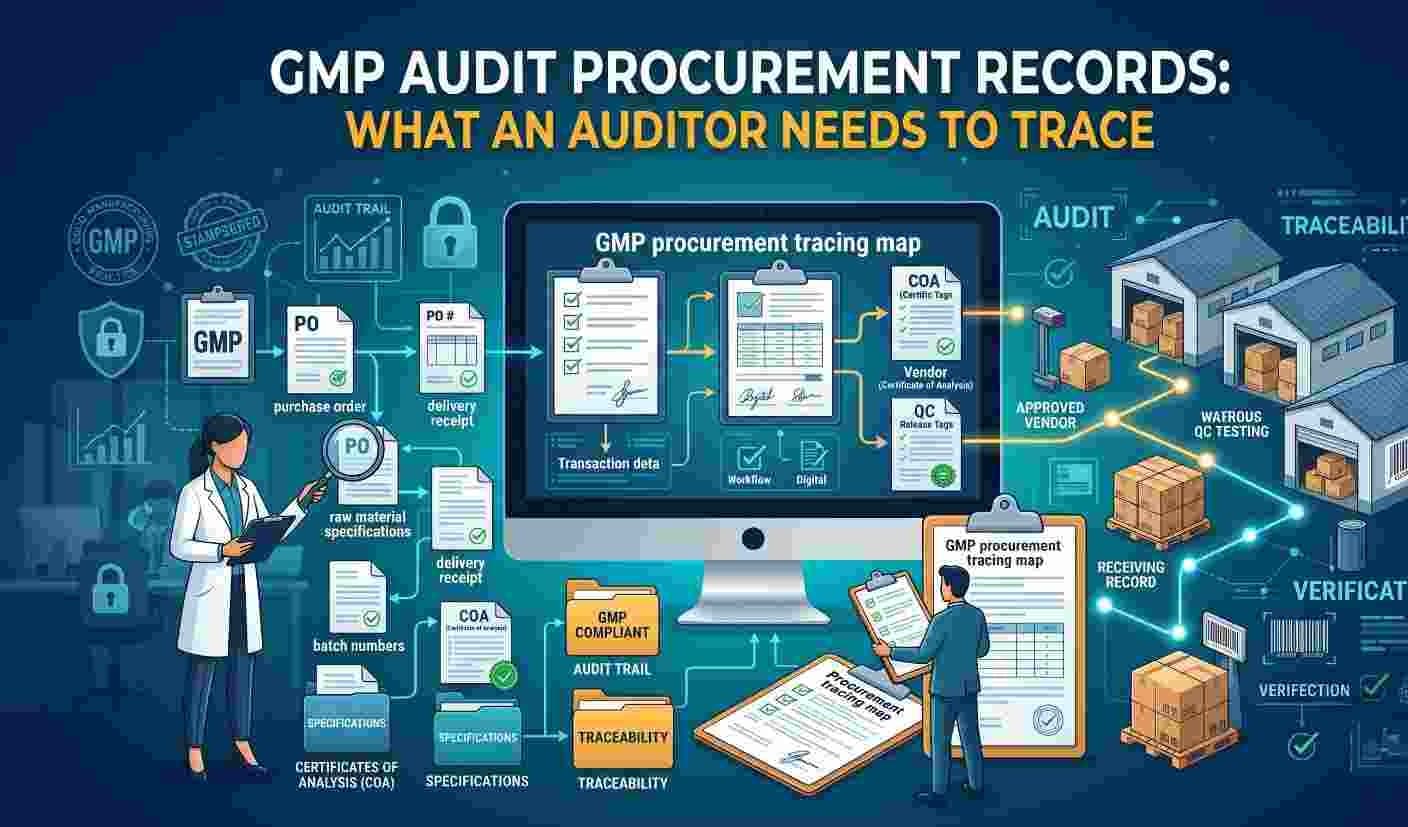
GMP audit procurement records in PRMAI: the vendor approval, order approval and GRN steps an auditor traces for one purchase.
Frequently asked questions
Does PRMAI make us Schedule M compliant?
No. It keeps the procurement records in one place, and your quality system decides whether they meet the rules.
Where do the receipt details stay?
The GRN is created in your ERP, and PRMAI fetches it back against the PO.
Our ERP already handles purchasing. Why add PRMAI?
You keep the ERP for PRs, POs and receipts. PRMAI sits next to it, pulls open PRs, creates POs in the ERP and fetches the GRN back, and holds the supplier onboarding and approval steps around those records.
When don’t we need this?
If one batch traces from receipt to supplier approval in minutes, without calling anyone, you already have the trail.
Start your fixes with the steps where you had to ask someone.
Book a demo to see the approval and vendor record trail for one purchase, from request to GRN.