
What 10 Years of Procurement Data Reveals About Supplier Risk (And How AI Fixes It)
Supplier risk doesn't announce itself. It builds quietly — a missed delivery here, a quality dip there — until one day your production line halts, your CFO is asking hard questions, and you're scrambling to find an alternative supplier in 48 hours.
Most procurement teams are managing supplier risk the same way they did 15 years ago: spreadsheets, quarterly reviews. Meanwhile, supply chains are more fragile, more global, and more complex than ever.
At PRMAI, we've spent the last decade building the most comprehensive procurement intelligence database in the industry — tracking real supplier performance data across thousands of organisations, industries, and geographies. What we found should fundamentally change how every procurement team thinks about supplier risk management.
The Real Cost of Reactive Procurement Risk Management
Before we get into the data, let's talk about what poor supplier risk assessment is actually costing you.
Across the organisations we've tracked over 10 years, reactive supplier management costs 3–5× more to resolve than proactive risk intervention. Teams that wait for problems to surface spend more time, more budget, and more goodwill fixing things that were entirely predictable months in advance.
Yet most procurement risk management strategies are still built around periodic reviews rather than continuous intelligence. That gap — between what teams know and what the data could tell them — is where supplier disruptions are born.
This is exactly the problem PRMAI was built to solve.
What a Decade of Procurement Data Actually Shows
Our procurement intelligence platform has been aggregating, analysing, and benchmarking supplier data for over 10 years. Here's what the data reveals — and why it matters for your organisation.
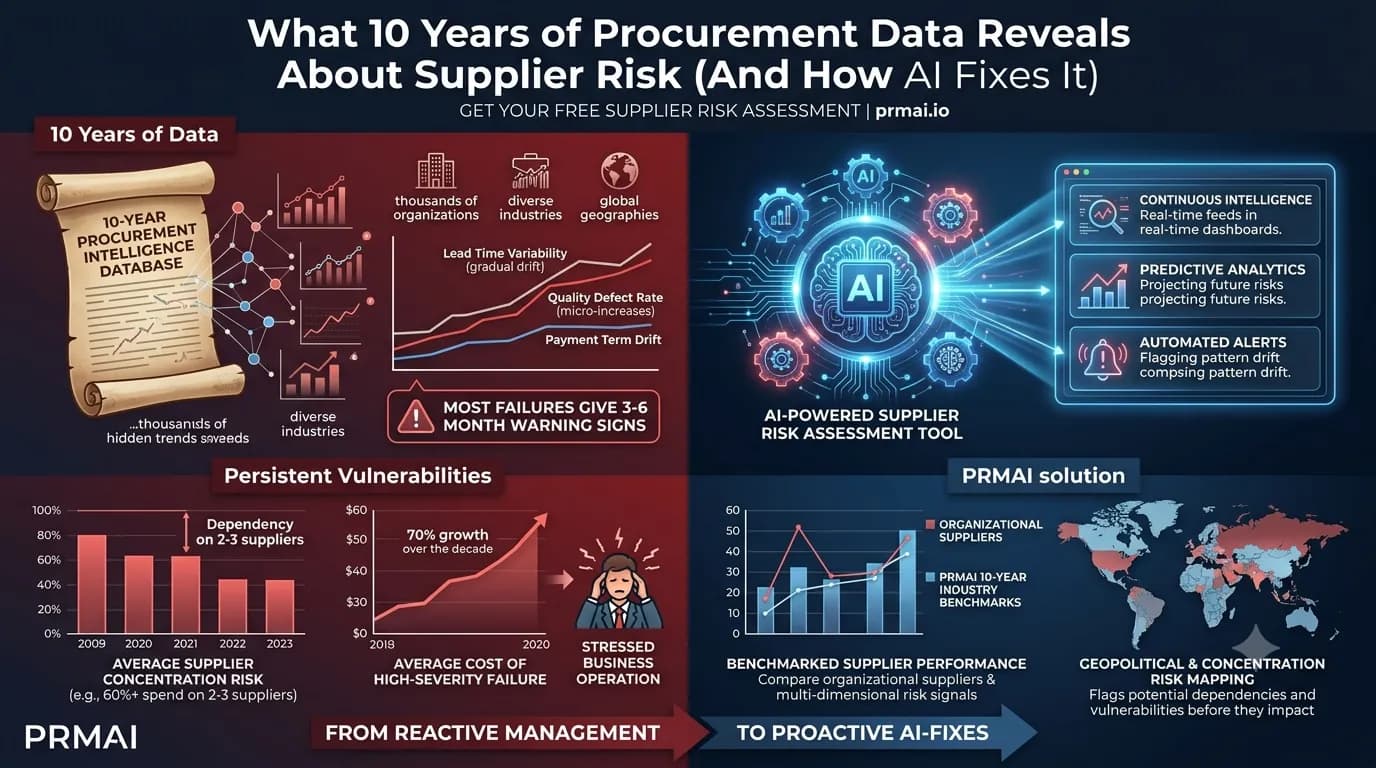
1. Most Supplier Failures Show Warning Signs 3–6 Months in Advance
This is the finding that surprises CPOs and procurement directors most. When we analysed supplier performance records across our 10-year database, a clear pattern emerged: the vast majority of supplier failures — late deliveries, quality failures, contract breaches — were preceded by detectable early signals.
Those signals include:
- Gradual increase in lead time variability (not a spike — a slow drift)
- Micro-increases in defect or return rates that individually look like noise
- Changes in payment terms or invoicing behaviour
None of these individually screams "problem." Together, they almost always do. The issue is that without an AI-powered supplier risk assessment tool aggregating and tracking these signals over time, human reviewers miss the pattern entirely.
How PRMAI solves this: Our platform continuously monitors supplier behaviour across all these dimensions simultaneously — flagging pattern drift months before it becomes a crisis. Procurement teams using PRMAI catch supplier risk early, not after the damage is done.
2. Supplier Concentration Risk Is Consistently Underestimated
Over 10 years of spend analysis data, one of the most persistent vulnerabilities we see is over-reliance on a small number of suppliers for critical categories. On average, organisations source over 60% of their critical spend from just 2–3 suppliers per category.
When one of those suppliers encounters problems — financial distress, capacity constraints, geopolitical disruption — there's no backstop. The procurement team scrambles, pays premium rates for emergency alternatives, and absorbs delays that ripple across the business.
The irony is that most of these teams had the data to see the concentration risk. It just wasn't being looked at through the lens of supplier performance management.
How PRMAI solves this: PRMAI's spend analysis software automatically maps your supplier concentration risk by category, flagging critical dependencies before they become vulnerabilities. You see the full picture — not just individual supplier relationships.
3. Industries With the Highest Supplier Risk Often Have the Lowest Monitoring Maturity
Our data shows a persistent mismatch between the industries where supplier failure is most costly and the sophistication of the procurement risk management in place. Manufacturing, construction, and healthcare procurement routinely face the highest disruption costs — yet these sectors also show the lowest rates of structured, data-driven supplier risk tracking.
The reason is partly historical: these industries built their procurement practices before modern procurement automation tools existed, and many haven't updated their approach since.
How PRMAI solves this: PRMAI is purpose-built for industries where supplier risk stakes are highest. Our platform brings enterprise-grade AI procurement software to teams of any size — without requiring a multi-year digital transformation to get started.
4. The Cost of a Single High-Severity Supplier Failure Has Grown by 70%+
In the early years of our data, supplier failures were costly but contained. Over the last decade — driven by tighter margins, just-in-time inventory practices, and more complex supply chains — the blast radius of a single critical supplier failure has expanded dramatically.
Across the procurement programs we've tracked, the average cost of a high-severity supplier failure (one that disrupts operations for more than 5 business days) has increased by over 70% when accounting for downstream business impact.
The procurement teams that fared best weren't the ones with the most suppliers. They were the ones with the best supplier performance management systems.
How PRMAI solves this: Because PRMAI benchmarks your suppliers against 10 years of real-world performance data, you're not just monitoring — you're predicting. Our platform gives you the visibility to act before a supplier problem becomes a supply chain crisis.
Why Traditional Risk Frameworks Are No Longer Enough
Most procurement teams use some version of a supplier risk matrix: probability on one axis, impact on the other, colour-coded red-amber-green. It's a useful communication tool — but it has three fundamental problems that no spreadsheet can fix.
- It's a snapshot, not a signal. A risk matrix tells you where things stood at the last review. It doesn't tell you where they're heading.
- It relies on human judgment over data. Ratings get inflated for long-standing suppliers. Relationships cloud assessments. Teams rate what they know, not what the data shows.
- It's updated too infrequently. In a fast-moving supply chain environment, quarterly reviews mean you're always working from stale information.
The organisations in our 10-year dataset that consistently manage supplier risk well have moved beyond the matrix. They use continuous, AI-powered procurement intelligence — tracking signals across delivery, quality, financial health, and responsiveness in real time.
That's the foundation PRMAI was built on.
How PRMAI's AI-Powered Procurement Platform Changes Everything
PRMAI is the only AI procurement software built on a 10-year database of real procurement performance data. That's not a marketing claim — it's what makes our predictions, benchmarks, and risk assessments fundamentally different from every other tool on the market.
Here's what sets PRMAI apart:
- Early warning, not late reaction — surface risk signals months before they become disruptions
- Multi-dimensional risk signals — monitor delivery, quality, financial health, and responsiveness simultaneously
- Benchmarks from real data, not theory — compare your suppliers against a decade of industry performance
- Prioritised attention for your team — AI surfaces what matters most, so your team acts where it counts
- Procurement automation that saves hours, not minutes — eliminate manual review cycles and free up strategic bandwidth
Is Your Supplier Risk Monitoring Leaving You Exposed?
If you're still relying on periodic reviews and manual scorecards, the gap between your visibility and your actual exposure is probably larger than you realise. Ask yourself honestly:
- Do you know which of your suppliers showed performance deterioration in the last 6 months — before it becomes a problem?
- Can you identify your top 5 concentration risks by category right now?
- If your second-largest supplier in a critical category had a major disruption tomorrow, how quickly would you know, and what would you do?
If those questions are hard to answer with confidence, your supplier risk management has room to grow — and PRMAI can close that gap immediately.
Supplier risk isn't unpredictable. It's under-monitored.
The data is there. The intelligence is there. PRMAI puts it all in your hands.
Ready to see how your supplier risk profile compares against 10 years of industry benchmarks?
See supplier risk monitoring in PRMAI: book a demo →