
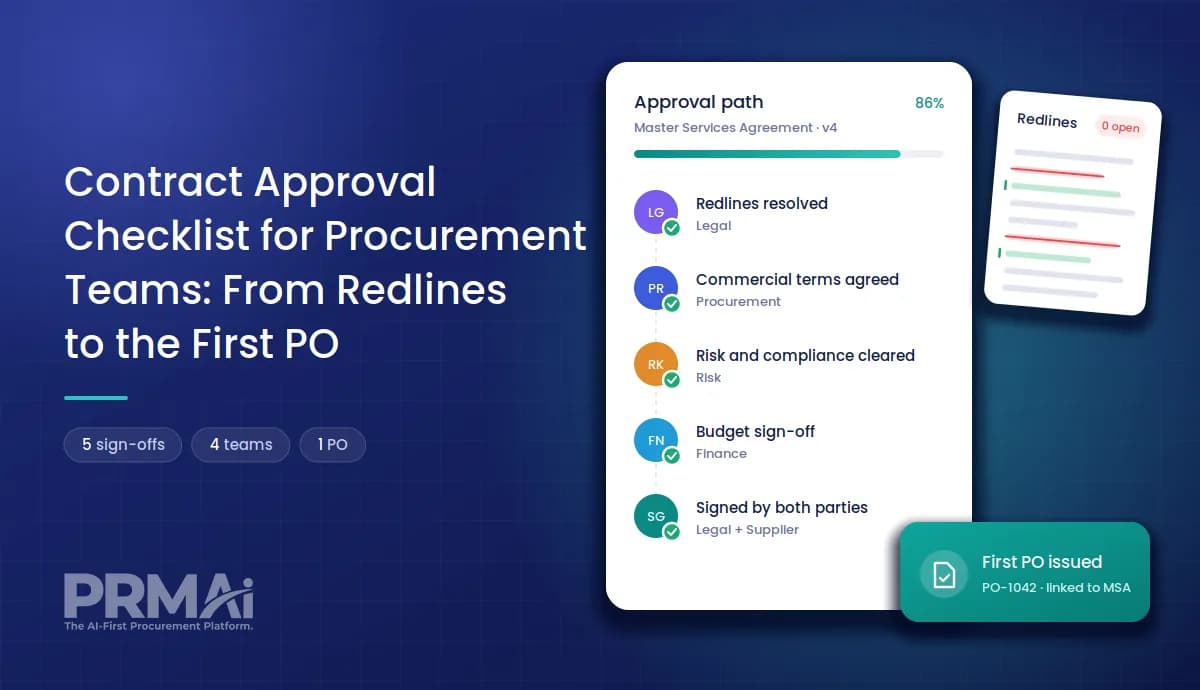
Contract Approval Checklist for Procurement Teams: From Redlines to the First PO
TL;DR: A contract approval checklist should cover the redlines, the approval route and the handover to purchasing. Route approvals by value and risk, so a ₹5 lakh renewal doesn't sit in the same queue as a ₹2 crore new vendor. Before signing, check supplier payment-term rules and data protection obligations. After signing, load the agreed rates and payment terms against the vendor before the first PO goes out, or the negotiated saving never reaches your books.
Say your team negotiates a new packaging supplier down by 6%. The contract then spends three weeks moving between legal, finance and the plant head. It finally gets signed, and two months later accounts payable is still clearing invoices at the old rate, because the new rate never made it into the ERP.
This checklist is for procurement heads and CFOs at companies with several plants or business units, where a contract has to clear legal, finance and IT before anyone can raise a PO against it. It follows a contract from redlines to the first PO raised against it. World Commerce & Contracting estimates that poor contract management costs companies about 9% of their bottom line.
What should procurement settle before redlines start?
Settle your fallback positions on the clauses that move money before the first draft goes to the supplier. Negotiations stall when the team has to go back internally for every counter-proposal.
Agree these with finance and legal in advance:
- Price and escalation: fixed for the term, linked to an index (WPI or a commodity index), or reopened on a set date.
- Payment terms: what you can offer, and whether the supplier is a micro or small enterprise (the law may cap the term, see the regulatory checks below).
- Liability cap and indemnity: the cap you'll accept, as a multiple of annual contract value.
- Termination: notice period, and whether you need termination for convenience.
Also write down who owns which clause. Procurement owns the commercials, legal owns liability, indemnity and IP, and IT security owns data access. When ownership is clear, legal reviews only the clauses it owns instead of the whole contract.
How should contract approvals be routed?
Route by contract value and risk, and let reviewers work in parallel unless one review depends on another. A single approval chain for every contract slows down small renewals and under-checks large new contracts.
Here's an example matrix. Set the bands and turnaround times to match your own spend and delegation of authority.
| Contract | Approvers | Target turnaround | |---|---|---| | Renewal on standard terms, under ₹10 lakh | Procurement head | 2 working days | | New vendor, or ₹10 lakh to ₹1 crore | Procurement head and finance head; legal if terms deviate from template | 5 working days | | Above ₹1 crore, or the vendor handles personal data or connects to your systems | Add legal, IT security and CFO | 10 working days |
Name a backup for every approver, and decide who the contract goes to when someone misses the turnaround. Let legal, finance and IT security review at the same time, and keep a sequence only where one review needs another's answer, for example when finance needs legal's liability cap before signing off on the commercials.
What happens after the contract is signed?
The agreed terms have to reach every PO and invoice, or AP keeps paying the old rate. This step decides what you actually pay.
Before the first PO goes out:
- Rate card, discounts and payment terms loaded against the vendor in your ERP or procurement system
- PO prices checked against the contract price, with any deviation needing approval
- Invoices matched to PO and goods receipt at the contract rate (three-way match)
- Volume discounts and rebates tracked against actual spend
- Your own obligations tracked, such as minimum order volumes
- Renewal date assigned to a named owner, with a reminder set at the notice period plus 30 days
Which regulatory checks should run before signing?
Before you sign, check payment-term rules for small suppliers, data protection obligations and the supplier's tax registration. In India, for example, a late payment to an MSME supplier can be disallowed as an expense, and a supplier who doesn't file GST returns can cost you the input tax credit.
Payment terms for small suppliers: check whether the law caps how long you can take to pay. In India, micro and small enterprises registered on Udyam must be paid within the agreed period, up to 45 days (15 days if there's no written agreement). Amounts still unpaid past that limit at 31 March are disallowed as an expense for the year (Section 43B(h) of the Income-tax Act, 1961, carried into the Income-tax Act, 2025), and late payment attracts interest under the MSMED Act. A longer term in the contract doesn't change this.
Data protection: if the vendor will process personal data on your behalf, such as employee, customer or patient records, check the contract against the data protection law that applies to you. India's DPDP Act, for example, allows it only under a valid contract (Section 8(2)), and the main obligations under the DPDP Rules, 2025 apply from 14 May 2027. The contract should cover security safeguards, breach notification to you, and deletion of data when the contract ends.
Tax registration: confirm the supplier's tax registration is active and matches its legal name. In India, that means checking the GSTIN, since your input tax credit depends on the supplier filing its GST returns.
How does PRMAI handle contract approvals?
PRMAI is a Source-to-Pay platform. Contract management sits in the same flow as sourcing, purchase orders, goods receipt and invoices, so the approved terms carry into every PO raised against them.
What customers say: Rishi R., Manager, Supply Chain at an enterprise company (1,000+ employees), gave PRMAI 5 out of 5 on 25 September 2026 in a review titled “Streamlined Procurement Management with Excellent Automation and Visibility.” He pointed to end-to-end procurement automation, workflows that follow the company’s own procurement policies, ERP integration, and real-time dashboards for tracking.
In practice: Rishi’s company loaded its negotiated rates into PRMAI, and every PO after that used the contract price. PRMAI has created 27,000 POs for his company.
- Reminders configured to your team’s needs, and a record of who approved what, with version history whenever a contract is modified.
- Contracts created per vendor, and extendable to multiple plants or sites.
- Clauses that differ from your standard templates flagged during review.
- Contract rates and terms carried into POs.
If you run an ERP, PRMAI works alongside it: it pulls open PRs from the ERP, creates POs in the ERP, and fetches goods receipt and payment information back.
Contract management is available on PRMAI's Growth and Enterprise plans. See all plans on the pricing page.
Frequently asked questions
What is a contract approval checklist?
A contract approval checklist is the set of checks a procurement team completes before and after a contract is signed: fallback positions, the approval route, legal and regulatory checks, and loading the agreed terms into purchasing.
What is contract redlining?
Contract redlining is marking up a draft contract with proposed changes, additions and deletions during negotiation, so both sides can see exactly what was edited.
Who should approve a procurement contract?
It depends on value and risk. In a typical value-based matrix, low-value renewals on standard terms need only the procurement head. Larger contracts add finance, and contracts above a set threshold, or involving personal data or system access, add legal, IT security and the CFO.
Does India's MSME 45-day rule apply if the contract says 60 days?
Yes. For micro and small enterprises registered on Udyam, the payment period can't exceed 45 days even if the contract agrees a longer term. Amounts unpaid beyond the limit at year-end are disallowed as an expense for that year.
What should a contract risk check include?
Supplier due diligence, liability and insurance, service levels, exit and renewal terms, data protection obligations, payment-term rules for small suppliers and the supplier's tax registration.
Before you sign the next one
Back to the packaging supplier: the 6% saving was lost between the signed contract and the first PO. In PRMAI, contract-to-PO carries the approved rate and payment terms into the POs raised against that contract, so the 6% shows up in what you pay.
Pick one contract waiting for approval today and run it through the matrix and the post-signature checklist above. If the agreed rate isn't loaded against the vendor yet, start there.
See how contract terms flow into POs in PRMAI