AI in Procurement 2026
Why 85% of Companies Are Already Winning with AI in Procurement (And What CPOs Must Do Next)
By Sanjana Thummala, Head of Delivery Operations
After more than two decades of supplier negotiations, contract renegotiations, and supply chain rebuilds through multiple global disruptions, one lesson holds true across the procurement industry: inflection points are unmistakable once you're in one. This is one of them.
Procurement has always been the function that quietly keeps the enterprise running — and the one that gets scrutinized hardest when costs rise or supply breaks down. What's changed in the last 24 months isn't the pressure. It's the toolkit. AI has moved from "innovation lab experiment" to "operational necessity," and the companies that treated it as optional are already behind.
Let's look at what the data is actually telling us — and what it means for procurement leaders who don't want to be the ones explaining to the board why a competitor got there first.
The Numbers Procurement Leaders Can't Ignore
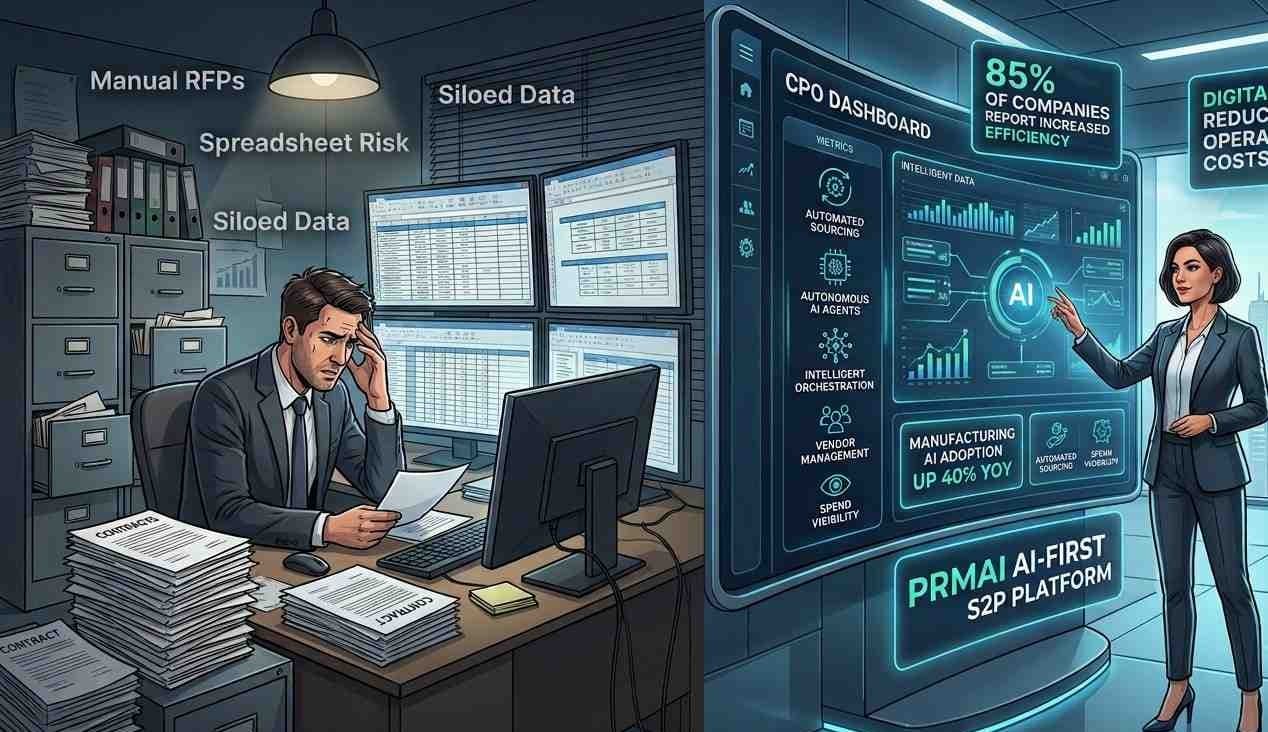
85% of Companies Using AI Report Increased Efficiency
This isn't a marginal gain. When the overwhelming majority of AI adopters report measurable efficiency improvements, the conversation shifts from "should we pilot this?" to "how fast can we scale it?" Efficiency gains in procurement typically show up in:
Faster cycle times on RFPs and sourcing events Reduced manual effort in contract review and compliance checks Quicker anomaly detection in spend data Fewer maverick spend incidents through automated policy enforcement
If your procurement function isn't seeing gains like this yet, the issue usually isn't the technology — it's the implementation strategy.
Digital Twins Reduce Operational Costs by 30%
Digital twins — virtual replicas of physical supply chains, warehouses, or production lines — allow procurement and operations teams to simulate disruptions before they happen. A 30% reduction in operational costs is a substantial number, and it comes from a very practical source: the ability to test "what if a key supplier fails" or "what if freight costs spike 20%" in a simulation instead of in real life.
For procurement teams still managing supplier risk with spreadsheets and gut instinct, this represents one of the clearest ROI cases in the current technology landscape.
AI Adoption in Manufacturing Is Up 40% Year-Over-Year
Manufacturing has historically been slower to adopt digital tools than industries like finance or retail — long asset lifecycles and complex physical processes make change harder. A 40% YoY increase in AI adoption signals that even the most conservative, capital-intensive sectors have decided the risk of not adopting now outweighs the risk of moving too fast.
If your suppliers, competitors, or industry peers are manufacturing-adjacent, this stat alone should be reason enough to accelerate your own roadmap.
What This Means for Procurement Leaders
Put these three data points together and a clear picture emerges: AI adoption in procurement and supply chain functions has crossed from early-adopter territory into mainstream expectation. The competitive risk has flipped. It's no longer about being first — it's about not being last.
The Solution: Closing the Gap with PRMAI
Knowing the stats is one thing. Acting on them without disrupting an already-stretched procurement team is another. This is where a purpose-built platform like PRMAI fits directly into the three problems above.
Solving the Efficiency Gap
PRMAI is built as an AI-first source-to-pay platform on autonomous AI agents and an intelligent orchestration layer that automates end-to-end procurement for enterprises. Rather than layering AI on top of manual processes, specialized AI agents handle sourcing, vendor management, purchasing, and invoice processing, all coordinated through a central orchestration engine that manages decisions and process execution without manual intervention.
That's the direct, practical answer to the 85%-efficiency stat: the gains come from removing manual handoffs, not just digitizing them.
Solving the Operational Cost Problem
Where digital twins simulate risk before it hits the P&L, PRMAI addresses the same cost pressure from the transactional side. The platform connects supplier onboarding, intakes, purchase orders, invoice processing, and spend visibility within a single procure-to-pay solution — exactly the kind of unified data layer that surfaces overspend, duplicate purchasing, and off-contract buying before it compounds. Peer reviewers highlight strong adaptability and configuration potential for procurement organizations, along with a capable sourcing solution that connects contract, supplier, risk, and performance modules together.
Solving the Speed-of-Adoption Problem
The 40% YoY jump in manufacturing AI adoption raises an obvious question for any CPO still evaluating vendors: how fast can we actually get live? On this point, customer feedback is notably consistent — one enterprise implementation was completed in about four weeks for the standalone system, with two additional weeks for ERP integration. For manufacturing and enterprise procurement teams that feel behind the adoption curve, that's a materially different timeline than a typical multi-quarter S2P rollout.
CPO Action Items: A Practical Roadmap
Here's how I'd advise any CPO — or any procurement leader building the business case for their leadership team — to move from "aware of AI" to "operationally ahead of it."
→ Evaluate Current AI Tools
Audit what's already in your tech stack. Many procurement teams are sitting on AI capabilities embedded in existing e-sourcing, contract lifecycle management, or spend analytics platforms that are underused or switched off. Start by asking your current vendors what AI features you're not yet using — and if the answer is thin, it may be time to benchmark against a platform like PRMAI that was built AI-first rather than retrofitted.
→ Plan AI Integration
Efficiency gains and cost reductions don't come from bolting AI onto broken processes. Map your highest-friction workflows — supplier risk assessment, contract review, demand forecasting — and prioritize integration where the data quality and process maturity can actually support it. PRMAI's modular source-to-pay structure means you can start with the highest-friction module (sourcing, invoicing, or vendor management) rather than committing to a full-suite overhaul on day one.
→ Monitor AI Advancements
This space moves fast. What was cutting-edge 18 months ago is now table stakes. Build a quarterly review cadence — even 30 minutes with your category managers — to track new capabilities, competitor moves, and vendor roadmaps so you're never caught flat-footed.
The Bottom Line
Procurement has weathered tariff shocks, pandemic-era shortages, and endless "do more with less" mandates. AI is not another mandate to survive — it's a lever to finally get ahead. The 85% of companies already seeing efficiency gains aren't the exception anymore. They're the baseline you're being measured against.
The question isn't whether AI belongs in your procurement strategy. It's how much longer you can afford to wait.
Want to see what an AI-first source-to-pay platform looks like in practice? Explore PRMAI to benchmark where your procurement function stands against industry leaders